
POWERING THE WORLD’S NEXT GENERATION
CLEAN AFFORDABLE LOCAL
We are a group of international SMR specialists deploying Small Modular Reactors in smart developing countries — delivering safe, carbon-free electricity at competitive prices, on short timelines, and with the local population at the centre of every project.
With We Are Specialists. We Build Energy Programmes That Work.
The Energy Organisation brings together engineers, financiers, policy experts, and on-the-ground partners to deploy Small Modular Reactors (SMRs) in countries that need reliable, clean electricity most. Our model is built around three non-negotiable principles: the price must be affordable for the host country, the timeline must be short enough to matter, and the local population must benefit directly — through jobs, training, and ownership.
SMRs are no longer a future technology.
Over 80 designs are in active development across 20+ countries. Commercial units are scheduled to begin operation between 2026 and 2030. The window to position developing nations at the front of this wave — rather than the back — is now.

Small Modular Reactors: The Missing Link to Net Zero
Small Modular Reactors are factory-built nuclear power units with an output typically ranging from 10 to 470 MW(e) per module. Unlike traditional gigawatt-scale nuclear plants that require 10–15 years and tens of billions in capital, SMRs are:
Factory-manufactured — components are built in controlled facilities and shipped to site, dramatically cutting construction time and cost
Modular — capacity scales with demand; start with one module and add more as the grid grows
Flexible in deployment — suitable for remote regions, islands, industrial zones, and countries with no existing nuclear infrastructure
Multi-purpose — beyond electricity, SMRs produce industrial heat (up to 700°C), hydrogen, and can power desalination plants
Technology types in active development:
Water-cooled · Gas-cooled (HTGR) · Molten Salt · Lead-cooled Fast · Floating Marine Units
Why SMRs beat conventional alternatives for developing countries:
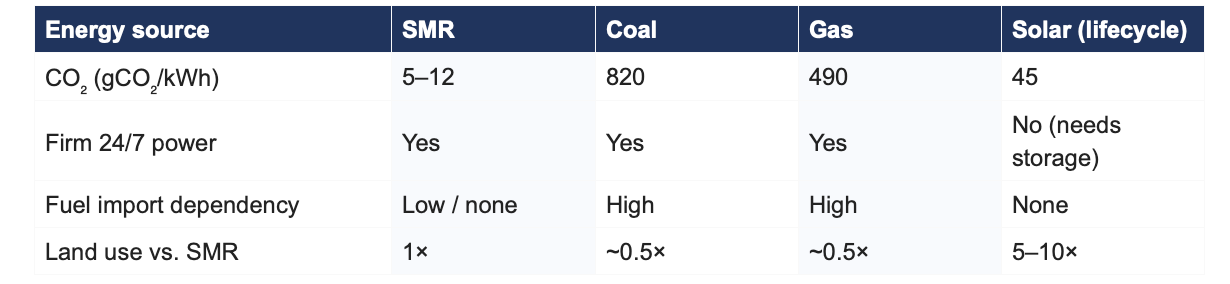
Traditional large nuclear is too expensive and too slow. Solar and wind, while cheap per MWh in raw terms, require significant battery storage infrastructure to deliver firm power — pushing the real cost of reliable electricity to $80–120/MWh. SMRs deliver 24/7 baseload power on a small footprint, without fuel import dependency, at a projected levelised cost of $60–100/MWh at scale — and that cost drops further with each successive unit built.

The Energy Organisation is led by a senior team
with decades of combined experience across nuclear engineering, project finance, international development, government relations, and construction management. We have worked on energy infrastructure projects across Africa, Southeast Asia, Eastern Europe, and Latin America.
Proven Track Record
Our team does not operate as consultants. We act as programme developers — staying involved from the first country assessment through to financial close, construction management, and commissioning. We bring the right technology partner to the right country, structure the financing, and ensure local capacity is built alongside the plant.

Unparalleled Vision
From site selection to grid connection, we manage the full lifecycle of an SMR deployment — reducing risk for governments, investors, and communities alike.

The Energy Gap Is Not a Future Problem. It Is Happening Now.
The current options are failing:
Diesel and heavy fuel oil — widely used across Sub-Saharan Africa and island nations, but at a cost of $200–400/MWh. Countries spend a disproportionate share of GDP importing fuel, and supply chains are fragile.
Large hydro — geographically constrained, increasingly vulnerable to climate-driven drought, and often disruptive to local communities.
Solar + storage — excellent for daytime residential use, but not yet cost-effective for 24/7 industrial-scale power, particularly in countries that need to industrialise.
Large nuclear — the cost and timeline (15+ years, $15–20 billion per plant) put it out of reach for most developing nations without major sovereign debt commitments.
SMRs fill the gap.
They are the right size for a developing country’s grid. They are deployable in 5–7 years from project inception to first power. They do not depend on coal, gas, or oil imports. And with the right public-private structure, they can be financed through export credit agencies, multilateral development banks, green bonds, and private capital — without overburdening the host government’s balance sheet.

SMR Programme — Investors & Partners Forum
Join our international forum for governments, institutional investors, development banks, and technology partners. Learn how the Energy Organisation structures SMR programmes in developing countries, review our target country pipeline, and meet the team.
Right Technology, Right Country
We assess each country individually — grid size, legal framework, existing infrastructure, political stability, and local skills base — and match it with the most suitable SMR design from the global portfolio of 80+ active programmes.
Affordable From Day One
Our financing structures minimise the cost of capital for the host country. By combining export credit, multilateral grants, private equity, and Build-Own-Operate models, we target electricity tariffs competitive with or below current fossil fuel costs in-country.
Local Population at the Centre
Every programme includes a local employment plan, a training and skills-transfer agreement with a university or technical institute, and a community ownership component. Energy independence means nothing if the local economy does not participate in it.
Short Timeline, Real Milestones
From programme launch to first power: 5–7 years. We pre-qualify sites, pre-engage with regulators, and work with technology partners that have modular, factory-ready supply chains. No decade-long delays. No 3× budget overruns.
Our Key Projects
Our Programme Model
1. Country Assessment and Partner Selection
We begin with a rigorous country-level assessment covering energy demand projections, grid infrastructure, regulatory environment, political risk, and financing capacity. We then identify the optimal SMR technology partner — drawing from a global network that includes GE Hitachi (BWRX-300), Rolls-Royce SMR, NuScale (VOYGR), Kairos Power, X-energy, Seaborg, and others — and structure a country-specific programme around their technology and deployment timeline.
2. Financing Architecture
Pre-execution costs for an SMR programme (feasibility, regulatory engagement, site assessment, legal structuring) typically range from $5–30 million per country — a fraction of the total project cost but critical for de-risking. The Energy Organisation co-invests in this phase alongside the host government and development partners. For main project financing, we access export credit agencies (US EXIM, UK Export Finance, JICA), multilateral development banks (World Bank, AfDB, ADB), and private infrastructure funds — structuring the deal to limit sovereign debt exposure.
3. Local Capacity and Ownership
An SMR programme is not a one-time infrastructure project — it is the beginning of a country’s nuclear energy capability. We build that capability deliberately: through partnerships with local universities and technical institutes, through local content requirements in procurement and construction, and through governance structures that give the host country a meaningful equity stake in the operating entity. When the plant runs, it runs partly under local ownership and with a locally trained workforce.
Leveraging cutting-edge technology and groundbreaking strategies, we're pioneering new ways to harness energy more efficiently and responsibly.
Through our tailored approach, we supports countries in building sustainable and resilient energy systems that are aligned with their economic, social, and environmental goals.
An Innovative Approach
Step into the future of sustainable energy with
The Energy Organisation

The Energy Organisation Advantage
Most energy developers bring technology or finance. We bring both — plus the programme management capability to hold the whole process together across governments, regulators, investors, and communities.
We are technology-neutral: we identify the best SMR design for each specific country context and negotiate on the host country’s behalf. We have relationships with leading SMR developers in the US, UK, Canada, France, South Korea, and Denmark.
We operate on a programme development model: we co-invest in early-stage costs, take a development fee at financial close, and retain a performance-linked equity stake in the project. Our incentives are fully aligned with successful delivery — we only win when the country gets its power plant.
We also do what most energy developers do not: we stay. Our team is embedded in-country throughout construction and into the first years of operation, ensuring knowledge transfer is real and not just a line in a contract.
An Integrated Approach.
Built for Smart Countries
Most large energy infrastructure projects in developing countries fail for the same reasons: financing falls apart, local capacity is absent, regulatory processes stall, and political transitions derail momentum. We have designed our programme model to address each of these failure modes directly.
Technology-neutral selection: We assess the full global SMR portfolio and select the technology that best fits the country — not the technology that pays us the highest commission.
Phased financing: We structure financing in phases, so the host government is not committed to full capital exposure before the programme is de-risked. Pre-execution funding, regulatory approvals, and financial close are separate gates with separate capital sources.
Regulatory pre-engagement: We begin regulatory dialogue in parallel with site assessment, not after it. In countries with no nuclear regulatory framework, we work with the IAEA and international partners to build that framework concurrently with technology selection.
Local skills pipeline: We partner with local universities and technical institutes to begin training nuclear operators, safety inspectors, and maintenance engineers from programme inception — not from commissioning. By the time the plant is ready, so is the workforce.
Build-Own-Operate options: For countries that want to minimise upfront capital exposure, we structure a BOO agreement with an international consortium, transitioning to local ownership over 10–20 years. The host country gets the power; the investors get the returns; over time, ownership transfers.

Safe by Design. Clean by Nature
Nuclear energy has the lowest lifecycle carbon emissions of any energy source — comparable to wind, and lower than solar when manufacturing is included. SMRs take this further with passive safety systems that do not require human intervention or external power to achieve safe shutdown.
Key safety facts:
Passive cooling: in the event of a total power loss, physics (gravity and natural convection) bring the reactor to a safe state automatically
The Emergency Planning Zone (EPZ) for most SMR designs is dramatically smaller than for conventional nuclear — in some cases, limited to the plant boundary itself
Smaller fuel loads reduce radioactive inventory at any one time
Factory manufacturing means tighter, more consistent quality control than on-site construction
SMR University: Building Local Nuclear Talent
Every country programme we develop includes a structured training pathway, developed in partnership with accredited institutions. Training covers nuclear operations, safety inspection, maintenance engineering, and regulatory compliance. Partner institutions include the World Nuclear University (WNU), IAEA training programmes, regional technical universities.
Trainees begin from programme inception — not from commissioning. By the time the plant is operational, a local workforce is ready to run it. This is what makes our programmes genuinely sustainable.